
Project Portfolio, Trending Events | Thursday March 12th, 2026 10:00 AM
Musalla Design: Public Space, Private Devotion
Inside a newly opened shopping mall in Bekasi, people move constantly. They browse, friends, and queue for coffee. Yet within that movement, there is a space designed for pause.
This project shows how thoughtful musala design can create stillness inside a public setting. A mall is built for activity. A musalla is built for focus. Therefore, the musalla design must balance two opposite conditions.
Design Narrative
A public prayer space needs privacy. At the same time, it must remain open and welcoming. This is where the spatial strategy becomes important.
The musalla is divided into male and female areas. However, instead of using solid walls, the design uses ceramic block partitions. As a result, each zone feels clearly defined without becoming closed off.
Light passes through the patterned surface. Air continues to circulate. Because of this, the room feels bright and breathable. It does not feel dark or stuffy.
In addition, the partitions maintain visual lightness. They create boundaries, yet they do not disconnect the space from its surroundings. This balance is central to good musalla design in public environments.
Rather than separating completely, the material acts as a filter. It protects the intimacy of prayer. At the same time, it preserves openness.
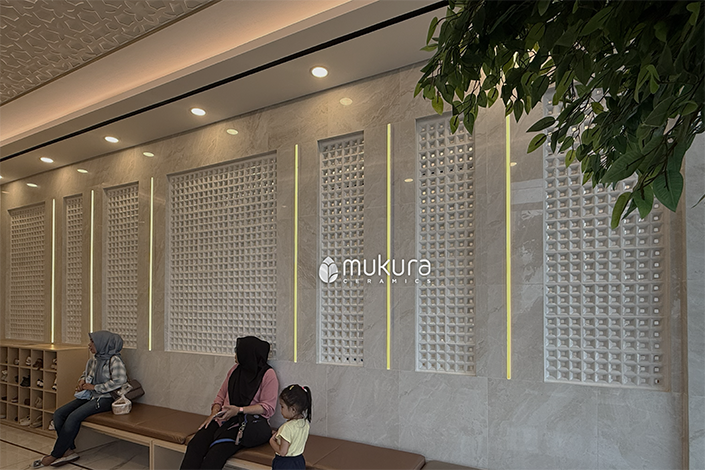
Product Specification
Product: Diagrid
Material: Porcelain-grade ceramic block
Color: White
Finishing: Glossy
Application: Interior partition wall
Installation Method: Wet installation
Diagrid was chosen for its simple and minimal form. Its geometry feels clean and structured. Therefore, it integrates easily into a modern interior.
As a porcelain-grade material, it offers durability and long-term performance. This makes it suitable for spaces that receive continuous daily use.
In Use
When completed, the musalla feels calm and organized. The partitions clearly separate male and female areas. However, the room still feels connected and airy.
Visitors step away from the noise of the mall. Then, they enter a space that supports quiet focus. The transition feels subtle but meaningful.
Ultimately, this project demonstrates how musalla design can shape experience, not just layout. It shows how a public facility can still feel personal.
Moreover, the same principle applies beyond commercial buildings. A prayer corner at home. A reading nook. A small space to reflect. Wherever privacy must coexist with openness, material choice becomes crucial.
In the end, good design does not simply divide space. Instead, it defines how we feel within it.
Discover more projects that explore how material intelligence shapes spaces that stay cool, bright, and climate-responsive.
Follow Mukura on Instagram and YouTube to see real applications and the stories behind each design.