Project Portfolio, Trending Events | Thursday January 8th, 2026 10:00 AM
Defining Private Space Without Closing It Off
In the Library and Archives (Dinas Perpustakaan dan Kearsipan) DKI Jakarta, the pantry and musholla form part of a shared break area. Beyond their functional roles, these spaces support moments of pause. In other words, a place to step away from work, gather quietly, or find calm during the day.
Within this setting, the praying area needed a sense of privacy, yet it could not feel isolated from the surrounding space. The solution was not to build a solid wall, but to introduce a softer boundary that respects both separation and openness.
Design Narrative
The pantry and musholla sit close to each other, serving different rhythms of use. One encourages informal interaction; the other invites stillness and focus. Rather than dividing them completely, the design allows both to coexist through a clear but gentle spatial definition.
A minimal partition frames the musholla, creating a dedicated area without interrupting the overall flow of the room. This approach reflects a growing design mindset: privacy does not always require enclosure. Sometimes, it only needs clarity.
Product Specification
Material: Porcelain-grade ceramic blocks
Finish: Glossy
Color: White
Application: Partition wall
Motif: Kinn
Installation Method: Wet
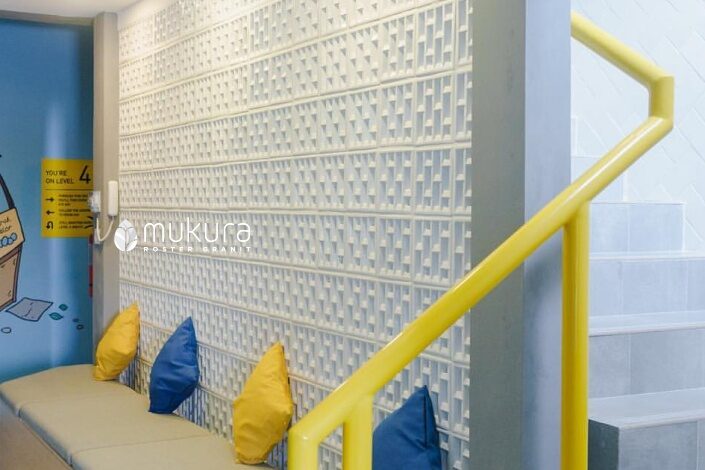
Kinn ceramic blocks are used as the partition wall for the musholla. Defined by simple geometry and a calm, minimal expression, the blocks form a surface that acts as both a visual and physical boundary.
Their open composition allows the space to remain light and connected. Instead of cutting the room into separate zones, the partition creates a layer; one that suggests separation while maintaining a sense of openness and ease.
In Use
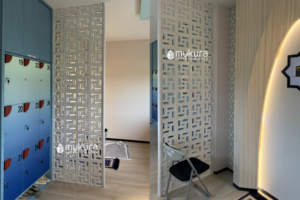
From the pantry, the partition reads as an architectural element rather than a wall. Its rhythm introduces texture, while its openness prevents the space from feeling tight or crowded.
Within the musholla, the effect is more intimate. The partition provides enough enclosure to support focus and privacy, without creating a sense of confinement. The space feels calm, breathable, and intentionally defined.
This same quality makes the application easily transferable beyond an office setting. The partition approach can work just as well in a home. For example, a small praying area, a reading corner, or a quiet spot to enjoy morning coffee. It offers privacy without asking the space to feel smaller than it is.
Through the Process
The design choice centered on flexibility. The partition needed to define a private zone while remaining adaptable to different contexts and scales.
Kinn’s modular form made this possible. Its ability to act as a boundary without becoming visually heavy allows it to respond to changing needs, whether in a shared office or a private home. What emerges is a design solution that prioritizes comfort, openness, and everyday rituals.
Curious to see how small architectural elements shape everyday moments?
Follow us on Instagram and YouTube for more real-life applications, spatial ideas, and design stories that explore how materials quietly define private space.